



The Pescia Paper Museum, of which Gambini is an “Impresa Amica”, is a place that keeps the tradition of handmade paper alive. In this interview, President Paolo Carrara talks about the Museum’s commitment to preserving a knowledge that keeps inspiring those, like us at Gambini, who work every day to innovate in the tissue industry.
Our Beyond business project, dedicated to those who have chosen our technologies, opens the door to a broader dialogue with those who serve as a link between the companies in the field and their local communities.
What is the mission of the Pescia Paper Museum?
Today, the Pescia Paper Museum, housed in the 18th-century Le Carte paper-mill in Pietrabuona, is committed to preserving the heritage of the paper industry, with its centuries-old history. The tangible heritage, from work tools to archives, and the intangible heritage, from technical knowledge to gestures, which we were in danger of losing. Today, it has been revived thanks to a new company, called Impresa Sociale Magnani Pescia, which has resumed producing handmade watermarked paper under the ancient Enrico Magnani Pescia brand.
Once upon a time, the mill wasn’t just a workplace: it was a true community, populated by entire families, which shared every aspect of life. Here, in the old Le Carte factory, owned by the Magnani family, up to eighty people lived together, for whom there was no separation between private and professional life: the company became a society, a culture, an identity.
What activities do you carry out to pass on this knowledge?
Alongside the restoration of the Le Carte paper-mill into a museum, we involved the master papermakers, watermarkers and seamstresses of the Pescia valley. Their knowledge was passed down through the field and for a long time they were reluctant to share it. They suffered the advent of machinery and technological tools, which made their knowledge obsolete – in industrial and production terms – almost overnight. For nine years, thanks to their generosity, we fostered an intergenerational transfer of skills related to the ancient art of handmade papermaking.
The last true master papermaker in Pescia was Angelo Vezzani, son of the “minister of the paper-mill”, the central figure who oversaw every stage of production. Angiolino, as he was known to everyone, even chewed the paper to recognize its fibers; or he would lick it and, holding it up to the light, assess its glueing.
What does the Museum’s historical archive consist of?
The Museum has been working on another valuable project for years: the restoration of the historical archive of the ancient Magnani paper-mills in Pescia. This extraordinary archive, spanning over three and a half centuries of production, is meticulously organized thanks to a forward-thinking and thoughtful corporate culture. The documentation, spanning over 700 linear meters, represents an inexhaustible source of information.
What collections does the Museum hold?
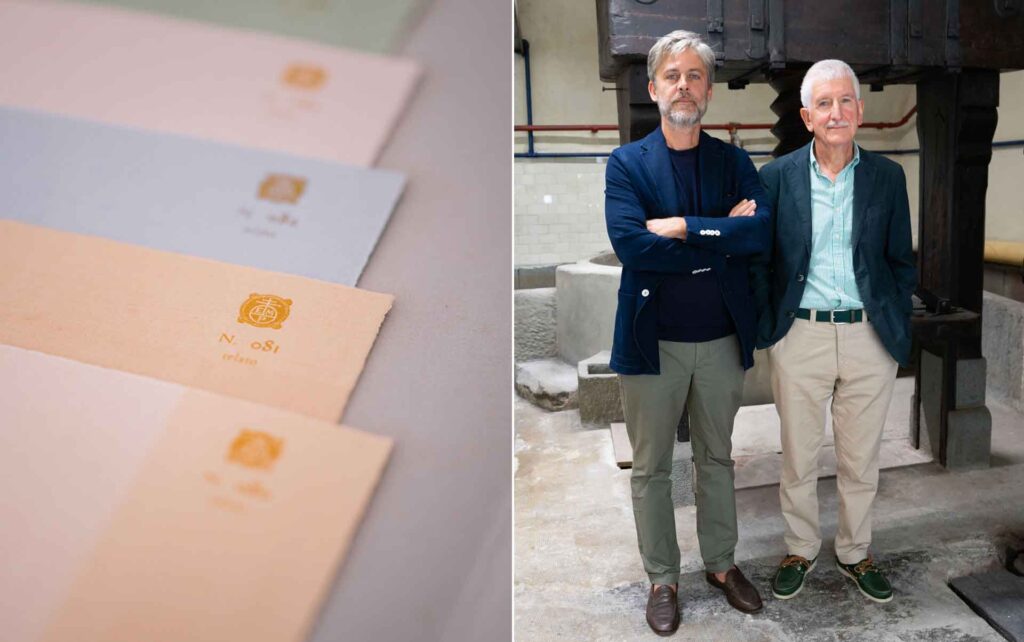
The Museum houses over 7,000 inventoried pieces (paper molds, punches, watermarked paper sheets, watermark waxes and stamps) and a “sample room” with more than 5,000 different watermarks. It includes watermarks for Napoleon and Ungaretti, papers produced for Picasso, De Chirico and Puccini, but also for institutions, diplomacy, art and design, sought after from every corner of the globe.
From work on the archive and collections, the oldest trademark of the Antiche Cartiere Magnani di Pescia also resurfaced: a cross of Lorena accompanied by the letters EMP, meaning “Enrico Magnani Pescia”. The trademark had never been registered, so, in an agreement with the Magnani family, we registered it on behalf of the Museum.
Have you also returned to producing handmade paper?
This very process led to the creation of an Impresa Sociale, made of people trained by the master papermakers and the Magnani heirs themselves, serving as President and Vice president, along with Massimiliano Bini, Director of the Museum.
A true company, making handmade paper using the old techniques, still unmatched by the industrial production process.
Each sheet is created, glued and finished individually, for a total of eight manual steps. A slow and precise process, now commercialized in the ultra-luxury segment, in sectors such as jewelry, hotels, stationery and fashion. Or with historical reenactments, as with the watermarks created for two episodes of the recent Italian TV drama dedicated to Giacomo Leopardi.
How did the paper-mill work?
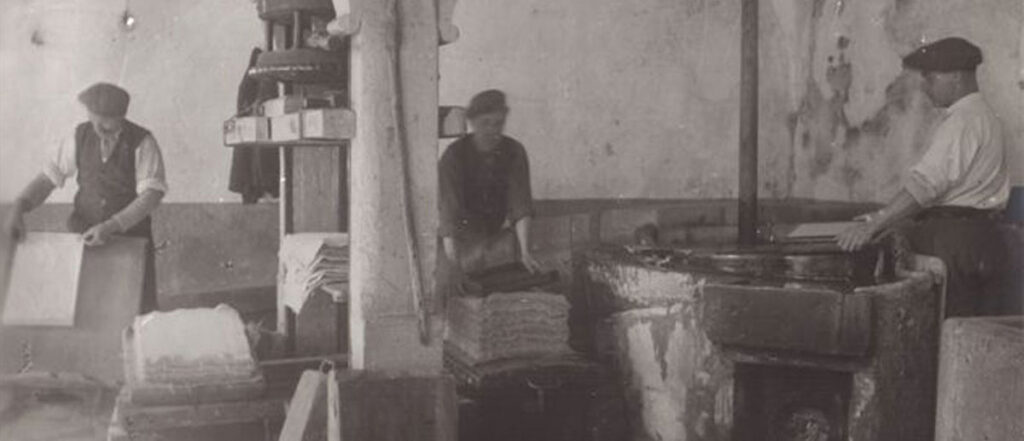
Before cellulose, and even before “damned nylon”, as Angiolino bitterly called it, paper was made from recycled cotton or linen clothing. Carts with bales of rags – and even ship sails, twice a year – were unloaded onto a big space in front of the paper-mill. No material was wasted: a true example of circular economy ante litteram, the kind we strive to recreate today. The rags were placed in the marcitoio, a humid, enclosed space where they were literally left to rot. Fermentation was an almost alchemical process, without any measuring instruments: the master papermaker would stick his hand into the mass to feel its heat and determine if it was the right time to move on to the next stage.
The rags were then processed by the shredding mills, enormous hammers that beat the mass until it turned into a fibrous paste similar to that produced today by modern pulpers. Alongside the mills was the olandese, which refined the resulting “pesto”.
Why were you born in Pescia?
The connection to the territory is ancient: in Pescia, paper has always been one of the most important products of the area. The origins of the modern Lucca paper district began right here, at the end of the 15th century, thanks to abundant water, stone for building and a culture of recycling already deeply rooted in rural life. At the beginning of the 20th century, Pescia had 28 paper mills, in Villa Basilica more than 40: a widespread network of small artisan businesses.
Those who today purchase a product manufactured in the Lucca paper district often do not know they’re using the result of a history spanning almost six centuries. This is why we launched the “Impresa Amica” project, opening the Museum’s spaces to companies, including non-local ones, that wish to embrace our cultural, historical and educational mission.
What are your future aspirations?
Recently, corporate museums have been transforming into true cultural centers. The Pescia Paper Museum aims to look even further. Here, there is not just a company to tell, but an entire region to promote: a widespread, shared, living heritage. We want to offer a place where corporate culture intertwines with the collective identity, memory and present of the paper companies operating in the area.
To preserve and develop this vision, a leap in institutional quality is needed: to this end, the Fondazione Le Carte will be established, which will also allow us to complete the restoration of the Le Carte paper mill and the completion of the Paper Museum. The foundation will be a publicly governed entity, capable of engaging effectively with European institutions, major players in the papermaking industry and the international network of paper museums.