


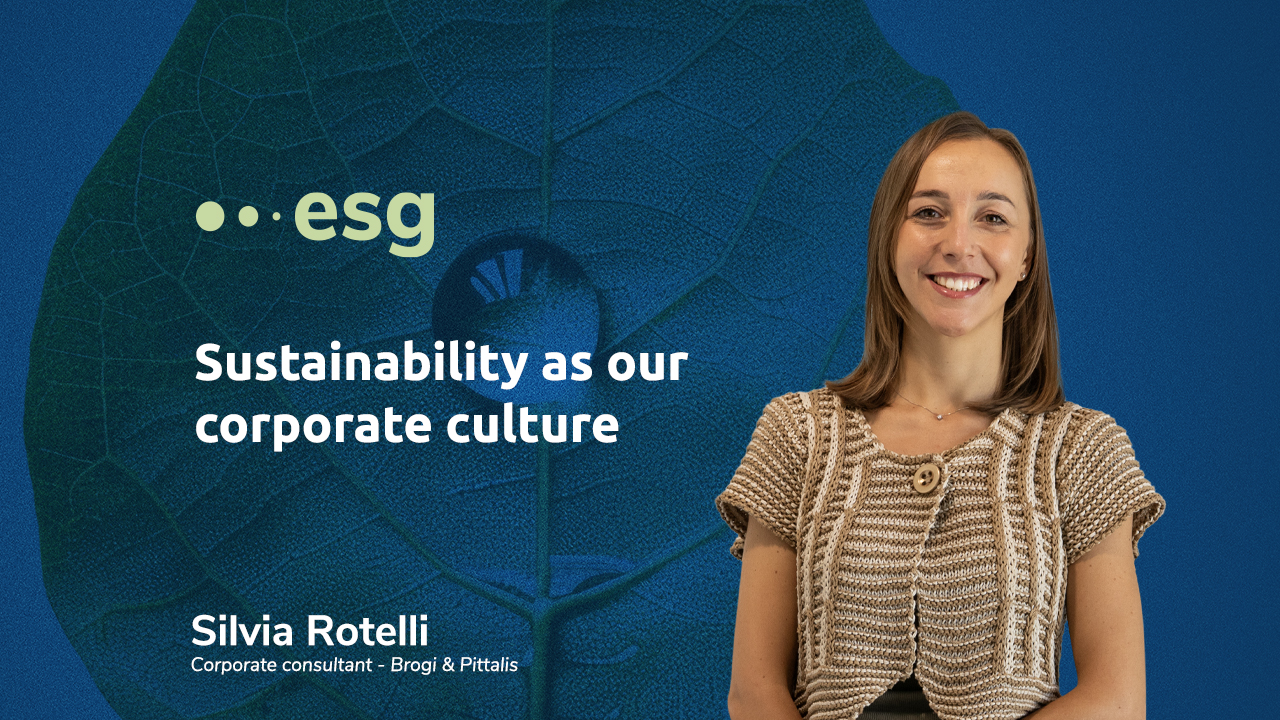

Our Sustainability Report is born from people: beyond those within Gambini, there’s one professional who helped us clarify our ideas. Silvia Rotelli, with Florence-based Brogi & Pittalis, is the person who helped us.
In this interview, Silvia tells us about her journey at Gambini: how she helped us enhance initiatives already present in our daily lives and how she guided us towards the drafting of “The mark we leave” and the Strategic Sustainability Plan we will implement in the coming years.
Silvia, tell us a little about yourself.
As a person, I’m a tireless enthusiast who hopes to change the way the world works. As a professional, I am a corporate consultant, focusing on organizational development and sustainability. My role is to help companies build a culture of sustainability by raising awareness, engaging people and helping them translate ESG goals into concrete actions. As I did with Gambini, I support them in defining their strategy, measuring and reporting their efforts and then in initiating change processes, especially through training. I really like to think of my work as a facilitator. Ultimately, I believe the value lies not so much in delivering a pre-packed document, but in providing the company with a method and a vision, allowing them to independently continue a journey and, why not, perhaps replicate it outside of the workplace.
How did you come to assist Gambini on its journey?
It all began with training. Gambini had been exploring sustainability issues for some time, interested in gaining awareness and skills. Thus began a training program consisting of meetings and aimed at several people within the company, who were able to gain insight into how sustainability was already embedded – or could be incorporated – into their work processes.
This awareness led to the next step.
What stage was the company at, when you arrived?
Initially, I found many scattered practices, some truly virtuous, but their implementation lacked a strategic logic. The impact, in itself, was already positive, but it wasn’t systematic: this led the company to undervalue what it was doing and to leave gaps in areas where it could have done a lot.

Who were the people you interacted with?
Quite a few! As soon as I arrived, I proposed creating a Sustainability Committee. Not all companies decide to do this, but at Gambini they immediately said they would. The Committee is made up of figures with multidisciplinary backgrounds, allowing us to gain a wide range of perspectives on the company and its sustainability issues.
My first contact was precisely with these people. Each of them represented a piece of the company’s history, a different vision on its strategy; when we developed the Strategic Sustainability Plan, this was crucial, allowing for a diverse perspective, also in terms of expertise.
But this was only the core team; later, to continue my work, I also connected with other people, starting with those who had been part of the initial training program, whom we wanted to keep connected throughout the Sustainability Report.
How were data and information collected?
More than just data collection, it was a matter of listening. Today, companies in general, and Gambini certainly does, produce a lot of data. But data has a story, right? Data has a purpose, so it was through dialogue with people that we tried to understand the story behind that information. And this greatly enriched the work, along with the subsequent analysis we performed on those data.
We developed tools that allowed us to collect data on natural, social, human, infrastructural and intellectual capital and to explain Gambini’s business model and its vision, through the voices of its leaders, the Committee and those I came into contact with.
What did you perceive in people?
I must say they always paid close attention to what I was saying; there was a lot of curiosity and presence, both during the training and the consulting process. I often received messages about things we had discussed in the classroom or in meetings, because the people I’d met had then independently explored that topic further to spark a new dialogue. So the issues were truly internalized.
And, as I was saying, presence, which isn’t such a given: sometimes we do things without fully “being there”, right?
This is because, at Gambini, sustainability wasn’t seen as a project or a “I’ll do it and deliver it” task, but rather as an ideal model to try to achieve.
But I want to add something else: I love my job very much and I do it with great passion, even if it’s truly demanding. Companies like Gambini are the places where I can do it at my best, because I’ve found a truly prolific environment dedicated to listening. Yes, I listened to them, but they also listened to me. A truly wonderful company, made up of truly wonderful people!
What noteworthy activities were already active in Gambini?
Certainly the many projects undertaken to benefit the local area and the community and the attention and dialogue with schools. These are some of the positive things I immediately noticed: initiatives that clearly convey their meaning of “doing business”.
Another element, which wasn’t seen from a sustainability perspective, but was already present, is machinery design. This sustainable approach was completely standardized within the company, without anyone ever realizing that highly durable machinery, first and foremost, creates less waste and, once it reaches the end of its life cycle, can begin a new one. At Gambini, it is allocated to other areas, sectors and activities that require a different, not less, technological development. And this means extending the life of machinery that would otherwise end up being disposed of, contributing to the vast amount of waste present on our planet.
Are there things you have implemented yourself or that Gambini will soon start doing with you?
Having developed a Strategic Plan, we’ve made a number of commitments.
We will soon begin a process on HR, a field in which Gambini is already well-established, but still eager to improve. Our analyses have shown that Human Resources has the potential to be strengthened and enhanced, working more deeply on issues such as diversity.
A lot of awareness on environmental impact, from emissions to water consumption, has now been gained, so we want to make the next step, deepening the analysis with a carbon footprint calculation. This, for example, is already a goal for 2027.
The Plan is developed in the short and medium term, precisely to set objectives to be implemented immediately, within a maximum of three years.
What are the prospects for the future and what advice would you give the company to continue growing along this path?
Don’t give up. Don’t give up, because today we live in a system that sometimes truly challenges those who embrace an ethical approach to business. We should always remember that a company is a social entity and, as such, has a responsibility: which doesn’t mean not aiming for profits, but rather viewing profit as a means for the development of those who run the company and for the development of the local community.
Beyond “don’t give up”, my advice is to continue to engage more and more people, because sustainability in a company only grows when it reaches into everyone’s daily decisions. And this begins when you have the courage to look at yourself and honestly measure yourself, to understand where you are today and to consciously choose where you want to go tomorrow. I must say that this is precisely what Gambini has done, is doing and, I hope, will keep doing.
We know that certain topics are close to your heart, even in your private life: tell us something about them.
I first approached these issues as a teenager: I felt something was missing and I began volunteering on projects focused on environmental protection.
Gradually, I shifted my focus to social issues. Today, I’m an activist at Casa delle Donne (Women’s House), in Florence, where I help with cultural initiatives, workshops and training programs on gender equality, relationship education, affectivity, health, rights, inclusion and even anti-discrimination programs.
It’s a space that offers associations, as well as individuals in the area, a place for planning, sharing and exchanging, to foster participation, civic engagement, critical thinking and thus the building of a community that values differences.
It’s certainly an experience that reminds me every day that change always comes from and with people, as well as from the type of relationship that develops between them. My work and my activism have the same goal: to create places and contexts where everyone feels safe to express themselves, to express who they are and build a future that – I hope – is more equitable, more virtuous and more humane.